
Reviewed · WALKING TOURS
Best of Buenos Aires Private Walking Tour
Buenos Aires reveals its secrets street by street. This private walking tour packs big architecture and small human stories into about 3 hours, from the Kavanagh to Recoleta. You also get a cemetery ticket built into the experience, which changes the value fast.
I love how the route connects neighborhoods instead of treating landmarks like one-off photo ops. You’ll walk Calle Florida as a historical spine, then hit Avenida Alvear’s French-style grandeur before you circle into Recoleta’s churches and aristocratic streets.
One thing to consider: it’s a true walking tour. Expect steady pace and a lot of time on your feet, and the exact coverage can shift if timing, weather, or street conditions change.
In This Review
- Key highlights to watch for
- The meetup: start on Florida at the right corner
- Calle Florida: shopping street, but also the city’s backbone
- Basilica del Santísimo Sacramento: beauty with a twist
- Edificio Kavanagh: the Art Deco star that changed the skyline
- Torre Monumental and the Malvinas/Falklands memorial context
- Plaza San Martín: independence stories tied to older layers
- Palacio Paz and Palacio San Martín: France across the façade
- Barrio Norte and Avenida Alvear: mansions, immigration, and the Paris label
- Embassy stops that turn façades into history lessons
- Shopping Patio Bullrich: British roots in a mall building
- The Santa Sede Nunciatura Apostolica: why the Vatican connection is local
- Recoleta first impressions: elegant streets and a monastic past
- Basilica Nuestra Señora del Pilar and the Recoleta Cemetery ticket
- La Biela and what you do next
- Pace, walking distance, and rainy-day reality
- Guides make the stories land: Mariano, Martin, and Carlos
- Is the price fair for what you actually get?
- Who should book this Buenos Aires Best-of walk
- Should you book Best of Buenos Aires?
- FAQ
- What time does the tour start, and where do I meet?
- How long is the walking tour?
- How much does it cost?
- Is the tour private?
- What’s included in the price?
- Does it run in bad weather?
- What sights will I see?
- When does it end, and where is the finish point?
- Are kids allowed?
- Is the full itinerary guaranteed to be exactly the same?
Key highlights to watch for
- Calle Florida history: why this old shopping street links Plaza de Mayo to Plaza San Martín
- Edificio Kavanagh: the tallest Art Deco skyscraper, plus how Corina Kavanagh made it happen
- Torre Monumental + Malvinas: the British clock tower story tied to 1982 memorial context
- Barrio Norte palaces: Paris-like mansions and immigration clues around Avenida Alvear
- Embassies with bite: stories behind the Israeli Embassy bombing and other landmark facades
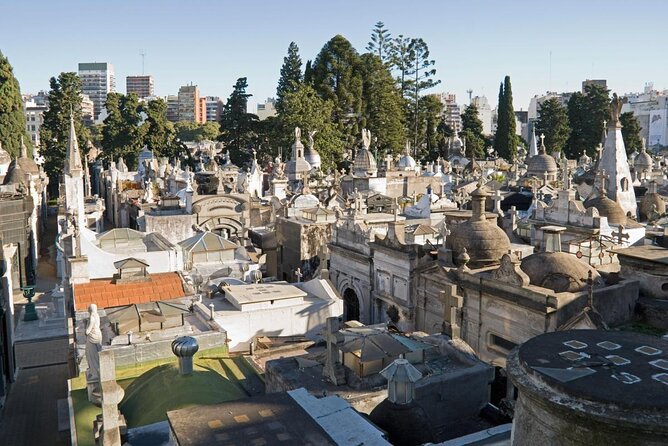
- Recoleta Cemetery ticket: a guided visit focused on famous names and local odd stories
More of Buenos Aires covered on foot.
- Buenos Aires Hop-On Hop-Off Bus, Free Walking Tours & Discounts★ 4.5 · 2,218 reviews
- Buenos Aires: La Boca Guided Walking Tour in English★ 4.8 · 1,587 reviews
- Nazis in Buenos Aires: a historical walking tour★ 4.9 · 193 reviews
The meetup: start on Florida at the right corner
You meet at Florida Garden, Florida 899, and your guide should find you by holding a small BA Walking Tours sign. The meeting point is the café corner at Paraguay St., and the tour starts no later than 10:00am—so don’t plan to roll in late.
This matters more than it sounds. Buenos Aires can move slowly at street level, and the best part of this tour is how quickly your guide starts tying streets and buildings into one story. Get there a few minutes early and you’ll feel organized before the walking begins.
Calle Florida: shopping street, but also the city’s backbone
Calle Florida (Florida Street) is one of the city’s oldest downtown streets, and you’ll walk it with context. Your guide explains how the boulevard connects the foundational area around Plaza de Mayo to Plaza San Martín (San Martín Park), so you start to understand Buenos Aires as a city of lines, not just dots on a map.
You also get built-in pacing. Early stops are short—think quick looks and “here’s what to notice” moments—so you can absorb architecture without burning your energy before the big highlights.
Basilica del Santísimo Sacramento: beauty with a twist
Next up is Basilica del Santísimo Sacramento, a family-built church with an almost storybook origin. It was built in 1916 by Lady Mercedes Anchorena for her family, and your guide points out why it’s so striking—and why the stories around it can feel complicated, even when you’re just standing outside looking up.
This is one of those stops where you benefit from a guide more than from a guidebook. Facades are pretty everywhere; the value here is learning what’s behind the walls.
Edificio Kavanagh: the Art Deco star that changed the skyline
Then comes the moment you came for: Edificio Kavanagh, the tallest Art Deco skyscraper in Buenos Aires and a declared UNESCO heritage building. It overlooks Plaza San Martín, so you get a good sense of scale—this isn’t a “small statue landmark,” it’s a skyline statement.
What I like here is the human angle. You’re not just told it’s Art Deco; you hear how it was commissioned in 1934 by Corina Kavanagh, an Irish-descent millionaire who sold two ranches at age 39 to build the landmark. Construction took 14 months, which makes the speed of the ambition feel real.
If you care about photography: this stop gives you clean lines and height. Dress for standing and looking upward—your neck will do some work.
Torre Monumental and the Malvinas/Falklands memorial context
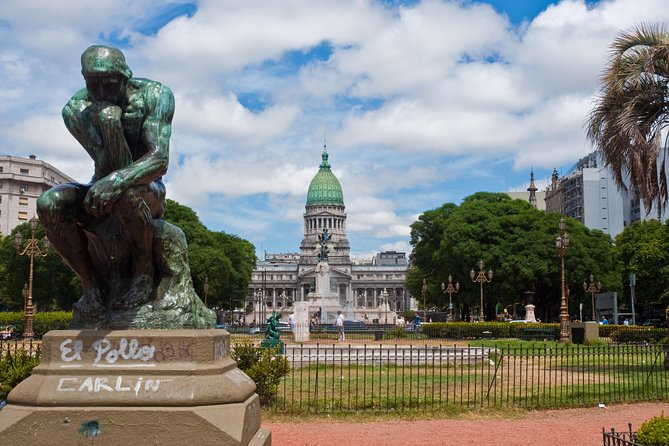
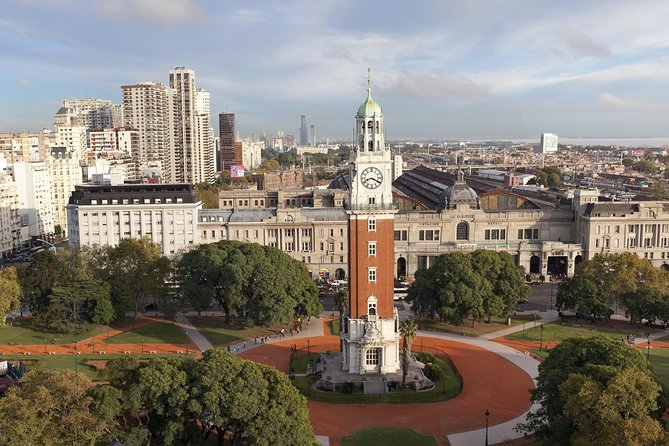
Across the plaza area you’ll see Torre Monumental (linked to the British Clock Tower legacy). Your guide explains England’s long shadow in Argentina, but the stop goes further by connecting the tower to the memorial context for the 1982 South Atlantic war (Malvinas/Falklands) just opposite.
It’s a meaningful pairing: a clock tower (seemingly neutral) beside a war remembrance (not neutral at all). Your guide uses that contrast to explain how history sits in the everyday city.
If you’re the type who likes to understand what you’re looking at before you move on, this section is a win. You’ll walk away knowing why a landmark matters beyond architecture.
Plaza San Martín: independence stories tied to older layers
You’ll pause in Plaza General San Martín, which is loaded with layers—your guide mentions it was close to old slave depots and that it previously held a fort and even a bullfight ring. Today it’s anchored by the big monument to José de San Martín, and you’ll get his story in full rather than in fragments.
What this does for your trip: it stops Buenos Aires from feeling like a “Europe-style postcard.” The city looks elegant, but it also carries the harder parts of its past. This tour doesn’t ignore that.
Palacio Paz and Palacio San Martín: France across the façade
Now you enter the palaces that give Barrio Norte its reputation for Paris-by-way-of-the-Southern Hemisphere.
At Palacio Paz, built in 1914 for José C. Paz, your guide explains the “how” and the “why.” It was made with materials imported from France, and the scale is what grabs you: 120 rooms for a family of four. That mismatch between size and everyday life is part of the point, and your guide brings it to life.
Not far away is Palacio San Martín, described as the Anchorena family palace (it’s called San Martín for political reasons). You’ll hear about Mercedes Anchorena, who built it and the nearby church for her family. Again, it’s not only architecture—it’s power, money, and who gets to leave an impression on the street.
Barrio Norte and Avenida Alvear: mansions, immigration, and the Paris label
You’ll get the “Paris of the South” explanation on your feet around Barrio Norte and Avenida Alvear. The route is designed so the elegance is not just seen, but interpreted.
On Avenida Alvear, you’ll stroll past lavish mansions and your guide ties the look to immigration from 1880–1930 and the rise and fall of Argentina in that period. The practical takeaway for you: you’ll learn how Buenos Aires’ style was imported and adapted, not simply copied.
One caution: this is still a walking street tour. If you’re sensitive to distance, wear shoes that don’t punish you after an hour.
Embassy stops that turn façades into history lessons
A couple of landmark buildings shift the tone from “pretty streets” to “people and consequences.”
At Plaza Israeli Embassy, your guide explains what happened in 1992, when a single bomb blast destroyed the embassy and 24 people were murdered. You’ll get the basics of what led to it and why it mattered, along with a bit of politics and justice in Argentina.
Then comes Embajada de Francia, originally the Ortiz-Basualdo Palace, where your guide shares historical gossip you’d never guess from the exterior alone. One example mentioned is a visit by Edward the 7th of England with his American wife-to-be. It’s the kind of story that makes a building feel connected to real people.
These stops can be heavy, but they fit the tour’s theme: Buenos Aires is a city of layers. Elegance and tragedy can sit a short walk apart.
Shopping Patio Bullrich: British roots in a mall building
Shopping Patio Bullrich sounds like a casual break, and it can feel that way, but it’s also an architecture-and-economy story.
Your guide explains how British influence is baked into the building’s identity. Patio Bullrich was designed by English Argentine architect Juan Waldorp, and it began as an auction house in 1867 for the Bullrich family—specifically for livestock sales like prize bulls and thoroughbreds. Later, it turned into a posh mall around 1990.
This stop is useful for you even if you don’t shop. It teaches you to read Buenos Aires buildings as symbols of commerce and power, not just decorations.
The Santa Sede Nunciatura Apostolica: why the Vatican connection is local
Another standout is Embajada De La Santa Sede Nunciatura Apostolica, where your guide connects questions people often have: Why is there an Argentine Pope? What’s the relationship between ultra-rich Argentine women and the church?
You’ll hear the story behind Adelia Harilaos, including that she donated her palace to the Vatican. It’s a rare moment where the tour turns from “look at this beautiful thing” into “understand why this thing exists.”
Recoleta first impressions: elegant streets and a monastic past
Recoleta is where the tour leans into atmosphere. Your guide notes the Recoletos Franciscan monks were given the land as a gift, and today it’s known for affluent neighborhoods with Paris-style townhouses, lavish former palaces, and upscale boutiques.
This is also where you begin to notice how much of the city’s “European feel” comes from specific planning and specific eras, not just vibes. You’ll feel that as the walk continues toward the churches and cemetery.
Basilica Nuestra Señora del Pilar and the Recoleta Cemetery ticket
You’ll visit Basilica de Nuestra Señora del Pilar (finished 1732), described as the second-oldest church in Buenos Aires and built as part of the Franciscan Recoletos monastery.
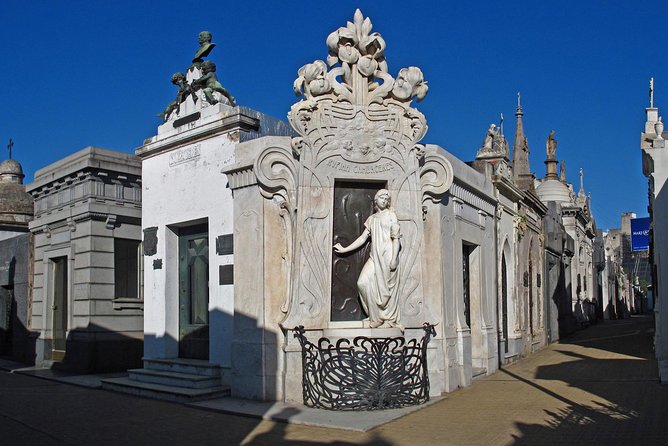
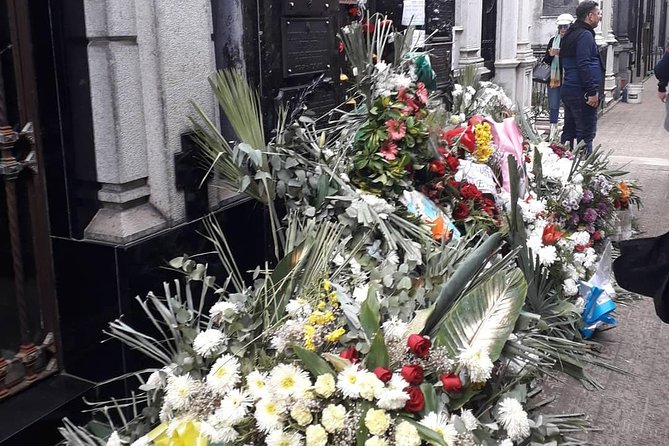
Then you get the part that turns the tour into a stronger value proposition: La Recoleta Cemetery with an included admission ticket. You’ll get a detailed guided visit with stops and explanations focused on famous figures and story-driven local characters, including Evita Perón and her memorial, plus a mix of other names and tales your guide uses to bring the cemetery to life.
Your cemetery visit is also framed through culture and art. The tour includes mentions like Palais de Glace, where tango is said to have come of age, plus history touching tango, ports, and immigration. You may also hear about monuments and institutions connected to France and Argentina, along with artistic and historical reference points.
Practical note: cemetery time is where you’ll likely feel the “guided” aspect most. Without a guide, you’d see names and statues; with one, you get context that makes the place feel understandable.
La Biela and what you do next
The walk ends outside La Biela café at Av. Pres. Manuel Quintana 596. This matters because you’re dropped into a lively district where you can keep moving at your own pace.
If you want a good next step, you’re set up to browse, grab a snack, or return to any place that caught your eye earlier—because this tour is designed to build that kind of confidence.
Pace, walking distance, and rainy-day reality
This is a long, steady walking experience. You’re looking at roughly 2.5 to 3 hours, and it’s not just aimless strolling. Stops are frequent but usually short, which keeps the story moving.
One review theme that shows up in how people describe the tour: it can feel like solid walking at a quick pace. So plan for that. Wear comfortable shoes, bring water, and if it’s rainy (the tour runs rain or shine), bring a light umbrella or a rain layer you can manage while walking.
Also know that the full itinerary may vary based on weather and city conditions. If you have strong priorities—like the cemetery segment—ask your guide early how your time will be managed that day.
Guides make the stories land: Mariano, Martin, and Carlos
A big reason this tour earns high praise is the guide performance. In past groups, names like Mariano, Martin, and Carlos show up with consistent patterns: strong English, confident storytelling, and a sense of humor that keeps the walk from turning into a lecture.
I’d treat this as a sign of what you’ll get: explanations that connect architecture to politics, commerce, and immigration—so you don’t just memorize facts, you understand why Buenos Aires developed the way it did.
Is the price fair for what you actually get?
At $109 per person, you’re paying for a guided walking route that covers a concentrated set of major sights plus at least 25 must-see attractions. You also get professional English-speaking guidance and a key admission value included with Recoleta Cemetery (and the Basilica del Nuestra Señora del Pilar is listed as admission included too).
If you’re the kind of traveler who likes to spend time learning rather than just collecting photos, the included admissions and the guide’s pace make the pricing feel more reasonable than “just another walk.” If you prefer to explore quietly on your own, you might still enjoy it—but you’ll want to decide whether you want stories with every block.
Who should book this Buenos Aires Best-of walk
This tour is a great match if you want:
- A tight orientation to central Buenos Aires with architecture and street-level context
- Stories about British influence, including the Torre Monumental and Malvinas/Falklands context
- A strong introduction to Recoleta that goes beyond the postcard view
- A guide-led visit that includes Recoleta Cemetery rather than skipping it
It’s less ideal if you hate walking, need lots of bathroom breaks, or want museum-style time inside multiple buildings. This is an on-the-street experience with a guided flow.
Should you book Best of Buenos Aires?
I’d book it if you want your first days in Buenos Aires to feel guided and coherent—Calle Florida to Kavanagh to Barrio Norte, then into Recoleta with the cemetery ticket in hand. The tour’s strength is how it connects elegance to history, and how it turns recognizable landmarks into understandable stories.
I’d think twice if you’re expecting a slow, relaxed stroll with lots of optional detours. It’s structured, it moves, and you’ll be on your feet. If that fits your style, this is an efficient way to get Buenos Aires to click fast.
FAQ
What time does the tour start, and where do I meet?
You meet at Florida Garden, Florida 899, outside the café corner door at the corner with Paraguay St. The tour starts no later than 10:00am, and your guide will have a small BA Walking Tours sign.
How long is the walking tour?
The duration is listed as about 3 hours (and the overall tour is described as roughly 2.5 hours of walking time).
How much does it cost?
The price is $109.00 per person.
Is the tour private?
Yes. It’s a private tour/activity, and only your group participates.
What’s included in the price?
A professional English-speaking guide is included, and you also get a Recoleta Cemetery admission ticket (and Basilica del Pilar admission is listed as included too).
Does it run in bad weather?
Yes. The tour operates rain or shine.
What sights will I see?
The tour covers at least 25 must-see attractions and includes stops such as Calle Florida, Edificio Kavanagh, Torre Monumental, Palacio Paz, Avenida Alvear, Recoleta, Basilica Nuestra Señora del Pilar, and Recoleta Cemetery.
When does it end, and where is the finish point?
It ends at La Biela at Av. Pres. Manuel Quintana 596, in the Recoleta neighborhood.
Are kids allowed?
Children aged 8 and under are free of charge when accompanied by an adult.
Is the full itinerary guaranteed to be exactly the same?
The full itinerary may depend on time and circumstances at the time of the tour, such as weather or city conditions.
More Walks Through Buenos Aires

Just added to our Buenos Aires notebook
- Guided tour Boca Juniors Museum & Stadium + Caminito
★ 3.3 · 3 reviews - Bike Tour: Buenos Aires to the North
★ 4.0 · 3 reviews - From Colonialism to Eclecticism, Buenos Aires arquitectonica
★ 5.0 · 3 reviews - Enjoy a Rural Experience in a Vineyard near Buenos Aires
★ 4.7 · 3 reviews - Café de los Angelitos – Traditional Night in Buenos Aires
★ 4.8 · 3 reviews - Buenos Aires: Rojo Tango Show with Optional Dinner
★ 3.4 · 3 reviews
Walking Tours, compared.
 ★ 4.8La Boca Guided Walking Tour in EnglishFrom $131,587 reviews
 ★ 4.9Nazis in Buenos Aires: a historical walking tourFrom $25193 reviews
 ★ 4.7Personalized 2 to 8-Hour Private Walking TourFrom $37149 reviews
 ★ 4.8San Telmo and Market Guided Walking TourFrom $13102 reviews
 ★ 4.5Buenos Aires Walking Tour with Local Guide and Optional RooftopFrom $11187 reviews
 ★ 4.8La Boca Art and History Walking TourFrom $4655 reviews
 ★ 5.0Full Day Private Walking Tour of Buenos Aires NeighborhoodsFrom $13555 reviews
 ★ 4.7Recoleta and Retiro Tip Based Walking TourFrom $150 reviews
Browse the lists this tour appears in